Your Cart
Items
Your Cart
0 Items
Vernier-Assist Controls
THE CONTROL LIKE NO OTHER - Vernier and Friction Lock - The Best of Both
Standard Vernier performance without the button!
Now FAA-PMA Approved!
- Jam-proof safety
- Precision power adjustments
- Smooth friction control
- Light and compact
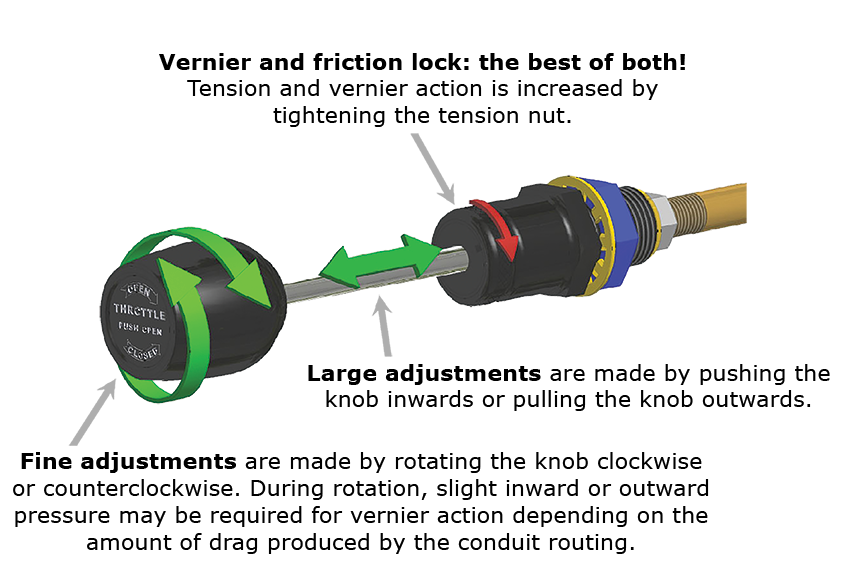
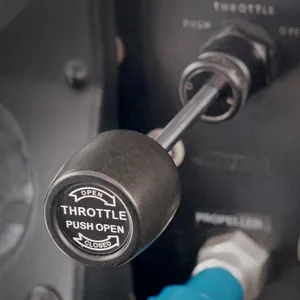
McFarlane’s patented Vernier-Assist™ offers the pilot precision control of the engine, unlike anything else on the market! The Vernier-Assist assembly operates on friction alone by simply turning the knob, with no threads or locking balls/pins. It also allows for normal coarse movement by pushing in or out on the knob. Unlike standard threaded vernier controls, this design cannot be jammed. The friction control provides smoothness and precision when operating the throttle and a friction lock secures the control in position, but it can be easily overridden in the case of an emergency. It is SAFE!
These light weight controls use a patented roller action and do not use a positive lock thread engagement. Coarse adjustments are made by pushing the knob inwards or pulling the knob outwards. Fine adjustments are made by rotating the knob clockwise or counterclockwise. For extreme conduit routing or heavy carburetor load installation, slight inward or outward assist pressure could be required during rotation.
Custom Vernier-Assist Controls also available. For more information go to Services.
Part Numbering Note: Part numbers for Vernier-Assist™ are the same as McFarlane's original push-pull FAA-PMA approved controls, except the "MC" prefix changes to "MCVA".
Examples:
- Standard Push-Pull P/N MC9863056-2 or Vernier-Assist™ P/N MCVA9863056-2
- Standard Push-Pull P/N MCS1222-1S or Vernier-Assist™ P/N MCVAS1222-1S
- Standard Push-Pull P/N MCC299505-0101 or Vernier-Assist™ P/N MCVAC299505-0101
MCTV Throttle Series: Vernier and friction lock - The best of both!
The new Vernier-Assist throttle control is adjustable for friction and vernier engagement and is available with three different end configurations. Requires a 3/4" panel hole. Available in a variety of standard lengths or can be custom fabricated to your unique requirements.
- Throttle Control with 10-32 threaded end: MCTV1035-LLL (knob included) or MCVA1035-20-LLL (without knob)
- Throttle Control with 1/4-28 threaded end: MCTV2035-LLL (knob included) or MCVA2035-20-LLL (without knob)
- Throttle Control with 5/64" dia 1x7 twisted stainless steel wire end: MCTV3035-LLL (knob included) or MCVA3035-20-LLL (without knob)
- Dual Throttle Control with 1/16" dia 1x7 twisted stainless steel wire ends: MCTV0005DLLL (knob included) or MCVA0005-30DLLL (without knob)
MCMV Mixture Series: Vernier action with only a 3/8" panel hole!
The new Vernier-Assist mixture control offers vernier action in a light weight, compact package. It is a drop in replacement for many existing non-vernier mixture controls because it only requires a 3/8" panel hole. It also only extends about 3.5 inches behind the dash making it ideal for aircraft with tight space constraints. Available in a variety of standard lengths or can be custom fabricated to your unique requirements.
- Mixture Control with 0.061" diameter solid wire end: MCMV0241-LLL (knob included) or MCVA0241-03-LLL (without knob)
MCVA Universal Series
Although not specifically a prop control, the MCVA series controls can be used with a 6730 Knob as a prop control for non-certified aircraft. Available in a variety of standard lengths or can be custom fabricated to your unique requirements.
Knob is not included. Requires a knob with 1/4-20 thread.
- Control with 0.061" diameter solid wire end: MCVA0241-00-LLL
- Control with 10-32 threaded end: MCVA1035-20-LLL
- Control with 1/4-28 threaded end: MCVA2035-20-LLL
- Control with 5/64" dia 1x7 twisted stainless steel wire end: MCVA3035-20-LLL
- Dual Control with 1/16" dia 1x7 twisted stainless steel wire ends: MCVA0005-30DLLL
Operating Instructions
How to safely and properly use the Vernier-Assist Throttle Control
Vernier-Assist gives unparalleled control in both fine and gross inputs of your throttle. To achieve this performance, it is important to understand how to properly operate the Vernier-Assist mechanism.
As stated, the Vernier-Assist can provide traditional gross throttle inputs for engine run-up, take-off, or any other flight condition. This is achieved, like traditional controls, by releasing the friction lock, making those large changes to control position, and then locking the friction control to hold the commanded position. While the friction lock is engaged, fine adjustments can also be made by rotating the knob of the throttle clockwise to advance the control, counterclockwise to retract. This mechanism gives superior control by allowing very minor adjustments with little to no effort by the pilot. It is a great improvement over other controls with the level of refinement possible; even over those with an existing vernier function.
It is important to realize that the Vernier-Assist is different than all other controls. The Vernier-Assist operation is dependent on locking the friction nut. This is achieved by turning the friction lock nut clockwise until it completely stops. In this position the control is held. By design the control can still be overridden by the pilot, operating like a standard push-pull control, but will not wander on its own. It is also in this tightened position that optimum performance of Vernier-Assist is possible. If the friction nut is loose or not in the tightened position, the Vernier-Assist will not perform as well and can lead to a slippage and un-commanded movement in control position. Vernier-Assist throttle controls may need slight inward and outward pressure during rotation to assist in the vernier function of making fine adjustments.