Your Cart
Items
Your Cart
0 Items
AOPA Article - MT Propeller
Clarifying Composite Propeller Certification, Safety, and Real-World Performance
A Response to Recent AOPA Coverage - By McFarlane Aviation Products
General aviation benefits from open discussion and thoughtful comparison of technologies. That dialogue, however, must be grounded in certification history, operational data, and a clear understanding of how aircraft systems behave in the real world.
A recent article discussing composite propeller technologies prompted questions among aircraft owners regarding certification timelines, safety behavior, and long-term maintainability. As the largest U.S. distributor for MT-Propeller, McFarlane Aviation Products believes it is important to clarify the factual record and provide additional context based on decades of certified fleet experience.
Aviation safety depends on trust—trust in engineering discipline, trust in certification standards, and trust in data learned through operational use. When technical distinctions are presented without full context, they can unintentionally create uncertainty rather than insight.
A Proven Certification and Operating History
Composite propellers are not new technology, and MT-Propeller has played a foundational role in their certified adoption, allowing the installation on most general aviation aircraft.
- The MT three-blade propeller was the first composite propeller certified on the Cirrus SR22, receiving FAA certification on November 30, 2000.
- MT subsequently certified its four-blade propeller on the SR22 normally aspirated (SR22NA) and the turbo-normalized (TN) model, including FIKI approval, on August 9, 2013.
These certifications were not incremental or limited approvals—they required full compliance with FAA standards for vibration, bird strike, lightning exposure, structural integrity, and environmental performance. They also established MT’s long-term presence in the GA marketplace.
A Global Fleet Backed by Real-World Data
The MT-Propeller fleet currently includes:
- 125,000+ composite blades manufactured
- 34,500+ propeller systems in service worldwide
- 200 million+ fleet flight hours
- Zero in-flight blade failures on any standard-category certified aircraft
This scale matters. It reflects not only successful certification, but predictable behavior across millions of takeoffs, landings, and operating environments—from flight schools and private owners to commercial and transport-category applications.
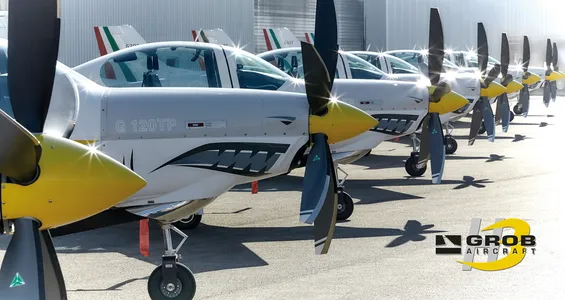
Understanding Certification Versus Marketing Claims
FAA and EASA certification establishes a pass/fail safety threshold, not a comparative ranking between manufacturers. Claims of “strength multipliers” or implied superiority can be misleading without understanding how certified propellers are designed to manage loads, impacts, and failure modes.
MT-Propeller blades use an epoxy-impregnated, plastified laminated wood core reinforced with carbon fiber, protected by nickel leading edges. This construction is fundamentally different from designs that rely on foam-based cores similar in composition to rigid insulation or cooler foam.
That difference becomes critical in abnormal events.
Propeller Strike Behavior, FOD, and Repairability
In the event of a propeller strike, MT blades are designed to fail in a predictable, contained manner. The blade typically breaks at the point of impact while the remainder of the blade stays attached and intact—often allowing the blade to be repaired or exchanged rather than scrapped.
By contrast, some foam-core composite designs can fragment during a strike, producing high-energy blade shards that pose a serious risk to occupants and people on the ground. In many cases, these designs are not repairable, requiring full propeller replacement.
MT’s approach prioritizes controlled energy absorption, repairability, and continued structural integrity—not just test compliance, but real-world survivability.
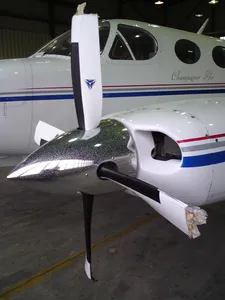
Maintenance, Logistics, and Cost of Ownership
Beyond safety, long-term ownership depends on how a propeller can be supported in the field.
- MT blades can be exchanged “on the wing,” eliminating the need to remove and ship the entire propeller assembly.
- MT propellers can also be assembled on the wing, allowing operators in remote regions to receive a propeller in disassembled form—significantly reducing freight costs and downtime.
- If an MT blade tip is damaged and 80% or more of the blade remains intact, repair is often possible without requiring purchase of a new blade.
- Minor blade damage can frequently be repaired in the field, on the aircraft, the applicable service literature is available for download at the MT Propeller website.
These capabilities are not conveniences—they are practical advantages that reduce downtime, lower total cost of ownership, and keep aircraft flying.
MT pricing also reflects this philosophy. For example, the MT four-blade propeller for the SR22 is approximately half the cost of other four-blade composite options, while offering unlimited life, certified performance and long-term support.
Vibration, Durability, and Structural Standards
MT’s plastified laminated wood core construction absorbs vibration more effectively than other composite approaches, contributing to smoother operation and reduced stress on the engine and airframe.
The nickel leading edges used on MT blades are widely recognized as among the most durable in the industry, providing exceptional resistance to rain, debris, and erosion.
Every MT aerobatic propeller is engineered to withstand more than 12G, and every GA MT propeller is built to the same structural standards—not a reduced or derivative design. This consistency is one reason all certified unlimited aerobatic aircraft manufacturers exclusively use MT-Propellers, and why world and national champions around the world continue to compete with them.
A Record Without Forced Scrappage
MT-Propeller has never been subject to an Airworthiness Directive that required owners to scrap a propeller at their own expense—a distinction that cannot be universally claimed within the industry.
This record reflects conservative engineering margins, predictable failure behavior, and a commitment to maintainability rather than disposability.
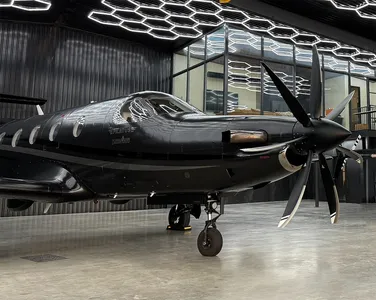
Elevating the Conversation
Constructive discussion strengthens aviation when it is rooted in certification science, operational data, and respect for engineering realities. When comparisons omit context or blur the distinction between testing thresholds and real-world behavior, they risk undermining the trust that aviation depends on.
McFarlane Aviation Products and MT-Propeller encourage aircraft owners and industry voices to evaluate propeller technology based on certified performance, documented fleet experience, maintainability, and total cost of ownership—not selective claims.
Aviation’s safety record was built on discipline, data, and accountability. That standard deserves to remain the foundation of the conversation.
Final Thought
Composite propellers have earned their place in certified aviation through decades of engineering discipline and operational proof. Informed decisions come from understanding how systems behave not just in tests, but across millions of real-world flight hours.
About McFarlane Aviation Products
McFarlane Aviation Products provides high-quality FAA-PMA aircraft parts and accessories for general, commercial and specialty aviation. With brands like CJ Aviation, Flight Resource (MT Propeller Distributor), Airforms and PMA Products, McFarlane delivers reliable aftermarket solutions backed by engineering excellence. As a major U.S. distributor for MT-Propeller, McFarlane supports general, commercial, and special-mission aviation operators with certified propeller systems and aftermarket support. As part of Victor Sierra, McFarlane continues to serve operators across general and business aviation.