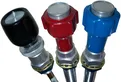
My Vernier-Assist Throttle control came apart during installation or maintenance. Can it be put back together?
Yes, this is common and can put back together, provided no components are missing. Please watch the Vernier-Assist Assembly Video for details.
What is the minimum bend radius for my engine control?
McFarlane's Storage and Packaging Specification requires a specific packaging minimum radius based on the length of the control, type of wire used, and the configuration of the control end(s). Please contact us to determine the exact requirements for your specific control.
What does the safety cable do?
The cable provides a backup restraint to help prevent clamp separation if the primary band were to loosen or fail.
How do I trim my engine control to length?
Please reference the Installation Instructions included with your new control.
How do I measure my control for custom manufacture?
To learn how to measure controls for custom manufacture see;
How to Measure Your Engine Control (Quadrant)
How to Measure Your Vernier Engine Control (Knob)
How do I clean and sanitize a McFarlane Push-Pull Control?
We make the following cleaning and sanitizing recommendations to be completed between flights:
Recommended Cleaning Process
1. Put on clean disposable gloves prior to cleaning and disinfection.
2. Pull controls back to the fully retracted position to expose the full length of the control shafts.
3. Apply isopropyl alcohol to a clean microfiber towel. Do not spray any solution directly on the controls or any other surfaces or components in the aircraft.
!!! WARNING: DO NOT USE BLEACH WIPES ON ANY MCFARLANE CONTROL !!!
4. Gently and thoroughly wipe down every control knob surface and control shaft.
5. Let cleaning solution dry on these surfaces (contact time).
6. Use a clean and dry microfiber cloth to wipe away any solution residue left on knob and control shaft surface.
7. Remove all gloves, towels, and cleaning supplies from the work area in the aircraft.
Please contact McFarlane Sales directly at 866-920-2741 or 785-594-2741 or sales@mcfarlaneaviation.com if you have any additional questions regarding the disinfection of our controls.
Can I adjust my new controller?
Yes, in most cases controllers will have a small amount of adjustment Available to “fine tune” the turbocharger system. Adjustment should be accomplished IAW the engine and/or aircraft maintenance manual. Be aware that over adjusting may render the component beyond field recovery which may require the unit be returned to a certified component shop for re-certification.
Why is my new engine control too long/short?
There are several things that could be different such as engine/aircraft modifications, rigging/clocking of control arm or adjustment of rod end will be needed, placement of clamps or brackets may be different, or a previous installation change such as routing from original.
Should I try replacing my tach cable core instead of purchasing a new assembly?
We recommend replacing the full tach cable assembly instead of only replacing the core. The old casing will have wear, and sometimes this wear will be enough to prevent a brand-new core from rotating smoothly when used with the old casing. We do not offer replacement cores; however, our full tach cable assemblies are an affordable alternative with better strength and reliability
My Vernier-Assist Mixture control came apart during installation or maintenance. Can it be put back together?
Yes, please return the control to McFarlane for repair.
I bought door cables that have small holes in the rubber coating. Is this normal or are the cables damaged?
The small holes are normal as they are part of the manufacturing process.
Can two SAFE-HEET engine heaters be connected to one temperature controller?
Yes, the 707 is rated at 600 watts. This is enough power to run two units by using a splitter.
Can I use temperature controller P/N 707 with a 220 Volt system?
No, you will need to use a converter that can supply 3 amps at 120 volts to operate both a SAFE-HEET and 707.
Why should I purchase a complete kit?
The kit includes the SAFE-HEET and temperature controller. The temperature controller makes installation easier and helps control condensation which leads to corrosion. It is like a dimmer switch that puts you in control of how much power is going to the unit.
What setting do I place the 707 controller to get my engine at a certain temperature?
This is determined by experimentation on knob settings and several variables such as ambient temperature, wind, size of engine/propeller combination and insulation of engine cowling.
What difference does a straight versus bent arm provide?
Bent-arm control provides faster response and improved durability. Straight-arm control allows for smoother steering and better control of break into free caster mode.
Do the 96301-01 mount cushions come drilled and tapped for the grounding cable required at the left front and right aft mount isolators?
Yes, the hole for the grouding strap is drilled and tapped, ready for strap installation as necessary.
What are some recommendations for installation?
1) Tach cable should be installed as straight as possible. The installed cable should be free of kinks, dents, and sharp bends, with no bends on a radius shorter than six inches and no bends within three inches of either terminal. Any deviation from these instructions is very likely to cause binding/jerking of the tach cable as it rotates, which will prevent the tachometer from reading accurately.
2) It’s unlikely to be an issue but ensuring that the hole in the engine ferrule is pointed downward when installing may help with oil drainage if the oil seal in the tach drive housing ever fails for any reason. If that seal fails in flight, and the oil can’t drain out of the drainage hole in the ferrule, it may travel up the tach cable into the tachometer and leak out of the instrument panel into the cabin.
Should I leave the heater plugged in all the time?
Yes, if the temperature is controlled to prevent condensation which can lead to corrosion.
Do you have any advice for installing a SAFE-HEET?
SAFE-HEET engine heaters are installed with a two-part adhesive. The engine heater can be installed quickly and easily by using the 707 temperature controller at half power. At temperatures below 70°F the temperature controller must be used to ensure proper adhesive cure. Proper adhesive cure is essential to full service life of the heater.
Why is my tach needle making a weird noise? Why is the needle moving abnormally
A noisy and/or inconsistent tach needle is a sign that something is likely wrong with the tach cable. If the cable is new, the problem is more than likely either in the installation or the lubrication of the assembly. In which case:
1) check the housing for kinks, dents, or sharp bends. Ensure it is routed as straight as possible. The more bends in the assembly, the more likely the tach cable will have issues rotating smoothly, especially as those bends get sharper or get nearer to one or both ends.
2) Disconnect your cable at the tach, hold it vertically by one end, and slowly rotate the core terminal by hand to check for smooth rotation. Any jerking may be an indication of wear spots, kinks, or breaks in either the core or conduit. Damaged spots on the core will snag on the inside of the conduit when rotating (or vice versa), causing the jerkiness in the tach needle.
3) Re-lubricate the assembly. Re-install per the maintenance manual instructions. Check the tach needle for steady and accurate reading.
4) If the problem persists, the cause is less clear. If the tach cable has been in service for some time, it may have become too worn to work correctly. Even if the core didn’t have obvious worn spots, kinks, or breaks during the earlier troubleshooting, the inside of the conduit/casing may have accumulated enough wear over time to prevent smooth rotation. A replacement will fix that. It may also be an issue with the tachometer itself if the normal troubleshooting steps don’t fix the issue.
What makes these clamps different from the OEM clamps?
They use a reinforced band design with an integrated safety cable for secondary retention and are not life-limited by the AD
How long should I let the adhesive cure?
Twenty hours at a temperature of 70 degrees. If using a temperature controller you can turn the thermostat to about 110 degrees and it will take about seven hours to cure
Is there a SAFE-HEET designed to be used with 240 volts?
No, neither a SAFE-HEET nor Temperature Controller should be plugged into 240 volts. You can use a system with an adapter that reduces the voltage to 110 and can supply at least 3 amps.
What are the pull strength ratings?
The 12" and 8" ties are 0.29" wide and are rated at 70 pounds, but our production quality control requires testing to >100% more than rated strength. This means they typically exceed 140 pounds.
Is PROP GUARD the same as the abrasion tape that I see advertised?
PROP GUARD is a very special high strength product manufactured to take the high centrifugal forces of the rotating propeller while being able to absorb impact energy. It goes through special heat treatments and careful quality controls. Only some of the material manufactured will pass our rigid quality standards. PROP GUARD is different.
How do I know if my universal joint needs to be replaced?
A universal joint attaches to each control yoke shaft behind the instrument panel. Universal joints are very precision. Replacement of the universal joint is required if any free motion or rust around the joint pivots is detected or if the joint fails inspection required by the Piper AD 2010-15-10.
What pressure is used to test the fuel selector valves after repairs?
We pressure test our repaired valves to a minimum of 5 psi using precision controlled air pressure and a calibrated low pressure indicator. This pressure is above the normal fuel pressure on the valve and below the limits of the springs in the valve. Each valve is submerged in Stoddard solvent while the air pressure is applied to the valve. The valves are then tested in each position to assure that there are no inter-port or external leaks. Leaks are detected by looking for air bubbles escaping from the valve.
My GFCI is not working.
Reference the troubleshooting instructions provided with the purchase of a SAFE-HEET. The GFCI will not work unless plugged directly into an outlet. Plug in the GFCI then the temperature controller. The GFCI needs to be the first thing plugged into the circuit. The GFCI needs full voltage to engage. It cannot have an extension cord plugged in the outlet, then the GFCI to the SAFE-HEET. The GFCI does reset itself every time it is unplugged.
How do you remove torque link bushings to install new ones?
Removing the flanged bushings from the torque link forging can be difficult as there is not a good surface to press against or grab onto. An easy way to remove them is to thread them with a tap, screw a bolt in the thread you made, and then drive or press against the bolt. The thread does not have to be a full depth thread for the bolt to hold securely in the bushing. The bushing material is somewhat hard, but not so hard that a standard hardware store tap will not do the job. Use cutting oil on the tap to prevent tap damage. Normally the bushing will then come out easily.
For stubborn bushings, soak the link assembly in boiling water before pressing the bushing. The heat will expand the aluminum forging more than the steel bushing. This helps loosen the press fit while limiting the temperature to prevent from overheating and harming the heat treat of the aluminum forging. A controlled oven can be substituted for boiling water as a heat source, but do not exceed 350° F. Do not use flame or other non-controlled heat sources.
An alternate method is to put dry ice in the bushing before driving or pressing on the bolt you threaded into the bushing. Do not over-press or hammer as the aluminum can gall to the bushing and leave a damaged bushing bore. If the bushing does not come out with light to moderate force take the time to use some heat or cold to help.
Is an overhauled Dry Air Pump as good as a new pump?
We can only speak for Tempest overhauled pumps as we have no control over the quality of other overhaul shops. Before Tempest®/Aero Accessories, LLC offered an overhauled pump, they spent more than a year in research and testing to determine what was required to produce a quality overhauled pump that would last as long as a new pump producing the vacuum or pressure required for aircraft application. In 1984 Tempest®/Aero Accessories, LLC had its overhaul process specification approved by the FAA and began offering quality overhauled vacuum pumps to general aviation. Tempest takes great pride in their state of the art overhaul facility, and produce the best overhauled pump on the market today. Over the years they have acquired FAA-PMA’s for all component parts of the Dry Air Pumps, and have supplied replacement parts to all overhaulers worldwide.
What does P/N MCSK100 roller upgrade kit do?
The Cessna Service Bulletin SEB95-3 describes damage to the flap support arms from the edges of the rollers cutting into them as the flap rollers rotate. Cessna fixed the roller end wear problem on the forward roller locations by installing a thin stainless steel wear washer between the roller and the flexible flap arms.
The aft roller location is more difficult as it is up in the flap structure and is rigid. The flap support arms will not flex open for the addition of wear washers like the forward roller location. The aft long roller position has the same wear problem as the forward roller locations. Since there is not room to install a wear washer with the existing roller, McFarlane designed a roller slightly shorter in length that allows room for wear washers on each end of the roller. The wear washers are designed with a step in them to make them an assembly that is easier to install.
Note that the upgrades do not change the aft narrow roller and shims/spacers that control the flap lateral end play. P/N MCSK100 only replaces the unprotected long aft roller(s) on each flap. Replacing the flap arms that have excessive wear is very expensive and time consuming. MCSK100 stops any further flap support arm wear.
My oil temperature seems to be running low. Is this a problem?
Yes, low oil temperature can lead to excessive rusting and corrosion of critical engine parts. When an aircraft sits on the ramp or in a hangar, the engine heats up during the day and cools again at night. While the engine is cooling, some of the moisture in the air condenses on the engine walls and drops into the oil.
This can form rust on internal engine components. The moisture can also react with by-products of combustion in the oil,forming acids which can lead to corrosion. The best way to remove this water is for the engine to boil it off during flight. Studies have shown that the temperature of your engine oil increases about 50°F as it circulates through the engine.
Therefore, unless the oil temperature reaches 170°F to 180°F during flight, the engine will not boil off the water that has accumulated in the crankcase. The result: rust and corrosion.
Note that an excessively high oil temperature will also cause problems. Here are some tips to help avoid oil temperature problems:
Check your oil temperature gauge for accuracy. It should read about 212°F when the sensor is placed in boiling water.
Monitor the oil temperature during flight. It should be about 180°F even in winter. If it is lower, you may need a winterization kit. Otherwise, check with your mechanic to see what is causing the excessively low oil temperature.
The unique additive feature in anticorrosion/antiwear AeroShell® Oil W 15W-50 can also help control problems caused by rust and corrosion.
Will the synthetic portion of semi-synthetic AeroShell Oil W 15W-50 harm an aircraft engine?
A number of pilots have asked this question. The answer is a definite no. When Shell first started evaluating multigrade aviation piston-engine oils over 25 years ago, testing proved that multigrades formulated only with mineral base oils did not have adequate base oil viscosity (thickness) to properly lubricate all high load points in the engine. Then we tested and flight evaluated a formulation made with all-synthetic base oils.
This formulation had excellent antiwear characteristics in all tests run. However, in the flight evaluations, some engines would reach 600 to 900 hours, then lose oil consumption control and/or compression. When the engines were disassembled, we found that the piston rings were covered with a gray tacky substance that was primarily made up of the lead by-products of combustion (from the use of leaded aviation gasoline).
Although synthetics are excellent lubricants with good high temperature stability and very good low temperature flow characteristics, they are relatively poor solvents.
In an aircraft engine, the lead by-products of combustion must be dissolved by the base oil so they can be carried away from the ring belt area and removed from the engine when the oil is changed. Anticorrosion, antiwear AeroShell Oil W 15W-50 is formulated with 50% synthetic base oils to give it the excellent low temperature flow needed for quick lubrication during cold starting.
The synthetic base oils, along with the unique antiwear additive system, give it antiwear protection unequaled by any other product on the market. In addition, its mineral base oils provide lead absorbency to guard against ring sticking and excessive sludge. The bottom line: The synthetic component of AeroShell Oil W 15W-50 will not harm your engine. Instead, it gives you the best of both oils.
Are lithium batteries safe?
Since inception in 2009, EarthX has designed their lithium batteries with a micro-processor-controlled battery management system (BMS) to provide safety and performance features for your battery. EarthX is not new to providing lithium iron phosphate batteries. Over the past 13 years, has become the most trusted and used lithium battery in the experimental aircraft market and by working closely with OEM’s and engine manufacturers a like, this BMS has been developed to be one of the most reliable in the industry. EarthX is not only the exclusive provider for the Indy Race Cars, but EarthX is also the first company in the world and in history to have an FAA TSO certified aircraft battery as a testament to the safety and quality of the batteries.
Features of the BMS protection:
- Cell balancing
- Low voltage protection
- High voltage protection
- Excessive Cranking Protection (Heat)
- Short circuit protection
- In the Hundred series, an alert LED fault light to communicate an issue on battery itself or can be remotely monitored with a 12V LED
- In the Hundred series, the BMS board is redundant so there is no single point failure
Battery design safety features:
- Proprietary battery case design with recessed terminals to protect from short circuiting
- Clam shell design with terminals down the center so polarity (installation) is never an issue
- Flame retardant plastic housing
- The state of the art ceramic cell separators to reduce the risk of thermal runaway by 400% over standard lithium cell separators.
Performance design features:
- The widest operating temperature range available
- A rated cells that must meet stringent testing requirements
- True industry standards testing specifications
How can I safely dissipate a static charge generated when refuelling?
Whenever fuel is poured, pumped or moved from one container to another, a static charge is generated. The same principle is in effect when you walk across a carpet in the winter and get a shock from a doorknob. The charge level and the distance that can be jumped or arced depends on several factors—pump rate, temperature, humidity and containers.
Static electricity is the reason why a ground wire is always connected to commercial airliners and transport trucks whenever fuel is being transferred. When you transfer fuel into your car or light aircraft, the hose has a built-in ground wire that acts as an electrical path to dissipate any static charge. As an added precaution, there is usually an excessively rich air/fuel ratio in the fill pipe which will not burn. There are two primary areas where a pilot should exercise caution when transferring fuel.
First is draining an aircraft tank. For example, if you’re draining a wing tank, you should always connect a jumper cable from the plane to the fuel container. This will dissipate the charge and eliminate the chance of a spark jumping from plane to container, causing a fire. Remember, when you’re draining fuel, there can be enough air circulation so that the air/fuel ratio is in the burnable range.
The second area of concern is the filling process. Many FBOs use a ground wire when filling an aircraft. But in some cases, fuel is transferred from a drum or can into an aircraft. Here, a jumper wire is a good safety precaution to ensure that the charge is dissipated. If you use a metal funnel with metal cans, make sure that the can, funnel and plane are always touching during transfer.
With metal containers, the electrical charge is dissipated to the conductive container where it can be discharged by a ground wire or contact. In plastic containers, there is no good electrically-conductive path to dissipate the charge. Although some people put metal strips into the plastic container, I would recommend the use of metal containers with a good jumper wire. It's the safer way to go.
My battery is dead or near zero volts, how do I recharge it?
The ETX-Series of batteries have over discharge protection and is designed to prevent a continuous active drain on the battery to the point of damaging the battery, such as leaving your key in the on position, master switch on your aircraft, or parasitic draw as examples. If your battery is reading 0V, or near 0V, then this protection might be activated.
To determine the actual voltage of the battery, remove the negative battery cable and measure the voltage at the terminals with a voltmeter. If less than 8V, it will not accept a charge. Once a lithium battery is approximately 8V, it can be permanently damaged and the EarthX BMS is designed to not allow the recharging of the battery as this is no longer safe to do and can be dangerous and cause cell rupture. Never force a charge into the battery. This is not a battery defect, nor a failed battery, but instead the protection working as it is designed.
The rate of discharge depends on how many amp hours the battery has (less Ah = faster discharge) and the ambient temperature (warmer = faster discharge). When the EarthX battery is about 95% drained, the BMS over discharge protection will disconnect the battery from the active drain so that you do not continue to discharge the battery to the point of damaging it. You know this has happened when you put a voltmeter on the battery installed in the vehicle and it reads close to 0V. We allow this much discharge of the battery to provide you the most energy possible if the drain is intentional, ie: your alternator fails in flight, and you are powering your electronics with the battery. The battery will continue to drain, at a much slower rate, with time as this is impossible to stop batteries from self-discharging. Even “brand new” batteries left in a box will drain and if not recharged and maintained, will be permanently damaged.
It is very important to recharge the battery immediately if it has been drained. The longer the battery remains discharged will shorten the overall life span and increases the chance of permanent damage.
Depending on the amp hour of the battery and the environmental temperature will dictate how much time can pass before it is permanently damaged. Example, the ETX12A is a 4Ah battery and should be recharged within a week whereas the ETX900 is a 15.6Ah battery and should be recharged within a month of finding it in this state.
How do I know if my steering rods are working properly?
The Cessna steering system is an engineering masterpiece that is simple in function while allowing good directional control throughout the transition from flight to ground or ground to flight, even in crosswind conditions. A key part of this system is the steering rods. The steering rods are a spring loaded device that applies spring pressure to pull on one side of the nose gear when it is activated and yet have a specified amount of free play in the opposite direction until a solid push is required for positive steering.
The following are some common symptoms of worn out or failed steering rods:
- Weak steering (You can push on the rudder but not much happens and you have to use a lot of brake to steer. Often the weakness is one direction only.) The early Cessna steering rod springs were designed such that if the rudder pedal was pushed hard in one direction while the nose gear was pointed all the way the other direction and had some resistance to moving such as soft ground or snow, the spring could be compressed to an extent that it would be permanently shortened leaving it weak. McFarlane has redesigned the spring so this cannot happen.
- More or less than 1.2 inches of free play movement or inconsistent free play of the steering rod shaft is present. The spring is retained by a washer that was stop swaged into the steering rod housing. During an overload, such as extra hard pedal force applied with the nose wheel pointed all the way in the opposite direction and restricted or undetected damage from a previous hard landing, the spring retaining washer can be deformed and forced past the swaged stop. This will result in inconsistent free play and erratic function of the steering rod shaft as the washer passes past its designed swaged stop in both directions. The rudder rigging in flight might also be inconsistent. This is a dangerous situation that results in inconsistent steering and the steering rod must be replaced. McFarlane has redesigned the washer and shaft machining to prevent the washer stop failure.
- Rust and corrosion can make the steering rods unreliable. The steering rods get water and contaminates from the runway that the nose tire throws at them. The fit of the shaft into the bushing that is swaged into the housing is not a precision fit. This can allow internal contamination, moisture, and salt that will rust the springs and steel housing interior, leaving the components weak and subject to failure. Red rust streaking on the shaft exit area or bubbling of the exterior paint indicate corrosion failure. The McFarlane steering rods are made from 304 stainless steel and have a special corrosion preventative and lubricating coating on the springs to fight against corrosion and wear.
- Wear of the shaft and bushing is caused by steering movement and aerodynamic pulse vibrations created by the rotating propeller. This wear can be detected as looseness of the shaft in the end bushing. Some wear is acceptable.