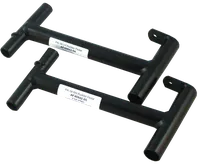
Does the brake line set include lines that go under the floor?
No, the brake line set only includes the exterior lines connected to the main landing gear legs.
What setting do I place the 707 controller to get my engine at a certain temperature?
This is determined by experimentation on knob settings and several variables such as ambient temperature, wind, size of engine/propeller combination and insulation of engine cowling.
What is the Plane Power AL12-EI60 (99-1012) internal regulator voltage set at the factory?
The Plane Power AL12-EI60 series alternator regulator is factory set to 14.2+/- .3 volts.
My Cessna 180/182/185 trim wheel will sometimes rotates out of position in flight, changing my trim setting. How can I fix this?
The trim wheels on the Cessna 180, early 182 and 185 aircraft have a spring loaded trim wheel stop catch assembly that engages with a molded in ratchet on one side of the trim wheel. This system is designed to prevent unwanted trim wheel movement caused by air pressure on the horizontal stabilizer. If these stop catch assemblies are worn out, the trim wheel is free to rotate. McFarlane has replacement stop catch assemblies.
How can I check my spark plug resistor?
First, the firing end of the plug must be cleaned of lead, carbon and oil. Once cleaned you can use the Tempest AT5K® or a multi-meter. If using an AT5K please see the tool section of our website. If using a multi-meter place one lead on the center electrode and the second lead on the contact point inside the spark plug terminal well. Be sure that your multi-meter is set to the correct setting.
Can I change the position of the housings on a new turbocharger?
Yes, the compressor and exhaust housings are factory set at a pre-determined position, many times for shipping purposes. The housings can be re-aligned at installation to fit the engine installation. The alignment procedure can be found under the turbocharger Installation Instructions on the Aeroforce.aero website.
What is the difference between the FS1-14 and FS1-14B?
The FS1-14 internal, non-adjustable regulator is set at 13.6+/- .2 volts. This alternator would be used as a back-up to an AL12-EI60 main alternator kit and would come online automatically if system voltage drops below 13.6 volts as in a failure of the main alternator.
The FS1-14B internal, non-adjustable regulator is set at 14.2+/- .2 volts and can be used as a stand-alone alternator system for aircraft wanting the lightest weight and using minimum equipment.
Because both alternators are driven from a slower accessory pad drive, these alternators will not produce output to support load until they reach approximately 2000 engine rpm. Perfect for a back-up system should the main alternator be lost in flight but limited as a stand-alone system as any installed equipment would be running off the battery during taxi and landing configurations.
Who can re-build the blades if they get damaged?
You, the owner, are authorized to make permanent repairs using common 2-part epoxy to common minor damage. The MT-Propeller Service Center in DeLand Florida has the equipment to rebuild your blades and even the hub in the event of prop strike or more severe damage. We also carry sets of exchange blades in stock for quick return to service for our customers.
What would cause the drive gear to break on my starter?
In some cases, engine kickback will fracture starter drive gears. Kickback is related to engine set up and can be anything from incorrect timing to problems with the fuel system. If kickback is noticed as a common occurrence on the airplane, diagnose and repair the problem or the replaced starter drive may fracture again. Many of Sky-tec's current starters offer kickback protection.
I just installed my EarthX battery in my aircraft and started the engine and my charging amps was really high, is this normal?
Yes, this is normal. A lithium battery can and will accept a much higher charging current than an equal size lead acid battery. If your battery is not fully charged, your alternator can potentially output a current equal to or slightly above the alternator’s rating for a few minutes to top the battery off. Your fuse, breaker, or current limiting device should be sized approximately 20% above the alternator rating. Example, if you have a 40 amp alternator, use a fuse, breaker, current limiter set to 48 amps (or 50 amps).
What is the recommended oil consumption rate for my aircraft?
This is a question that doesn’t have a definitive answer. Oil can be consumed or lost by three different routes in an engine: the rings, leaks and valve guides. In a good, tight engine, there should be very little oil consumption or loss by the guides and none through the leaks. That leaves the rings as your primary concern. The amount of oil going by the rings will vary depending on cylinder type and break-in process.
Assuming that the cylinders were broken in properly, oil consumption can still vary depending on the type of service and how the aircraft is flown. Even two identical engines (like on a twin), operated the same way, may have different oil consumption rates. So what’s right? Engine manufacturers state that oil consumption of up to a quart an hour is acceptable on some models. (Some manuals for large radials say that anything over six gallons an hour is excessive.)
The best answer is that oil consumption will be at a certain level for each engine. Consumption changes shouldn’t be compared to an absolute level, but rather to the level that your engine sets historically.
How is the D A M product different than other anti-seize products?
D A M anti-seize works on the principle of very small particles of inert dry lubricants imbedding themselves into the open pores of the stainless steel. The dry lubricants lowers friction and prevent corrosive adhesion of the two stainless steel surfaces. The dry lubricants prevent combustion by products from actually gripping the stainless steel. Other products rely on powdered metal such as copper or nickel in a mix of greases and graphite. The powdered metals themselves are often corrosive to the stainless steel at high temperatures and actually create adhesion by microscopic corrosive residue. The old failed theory is that the metal powder flakes will separate from each other and allow disassembly. This does not work at high temperatures and with stainless steel. Any graphite in the compound (graphite is required for MIL SPEC anti-seize compounds) sets up a severe galvanic corrosion action with the stainless steel and the powdered metals that produces corrosive by products that swell and lock the joint while attacking the grain structure of the stainless steel. This corrosive action is accelerated at high temperatures and contact with combustion by products.
What are the specifications?
Specifications:
Materials:
Plastic:
- Zytel Nylon
- UV resistant black
- Toughened
- Heat stabilized
- Impact modified
- Nylon 66-1 ISO1043
- Non-magnetic
- Non-conductive
Elastomer Rubber Liner:
- Protection adhesion promoted thermoplastic elastomer
- ShoreA 58 A ASTMD2240
- Elongation at break >375%
- Compression set of 25% ASTM D395B.
Dimension and Strength Information:
- Rated pull strength: (pounds): 70
- Nominal width of the strap (inches): .29
- Nominal length (inches): 12.3
- Temperature limits:
- Operating temperature (-40ºF/-40ºC) to (221ºF/105ºC)
Flammability:
UL94, UL 746A, IEC 60695-11-10
Water Absorption:
Immersion 24 Hour ISO 62 0.9%