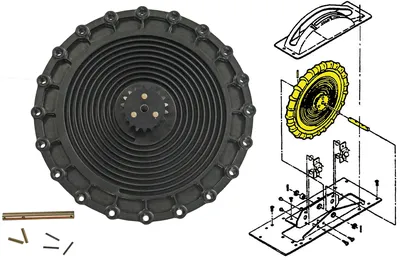
My Cessna 180/182/185 trim wheel will sometimes rotates out of position in flight, changing my trim setting. How can I fix this?
The trim wheels on the Cessna 180, early 182 and 185 aircraft have a spring loaded trim wheel stop catch assembly that engages with a molded in ratchet on one side of the trim wheel. This system is designed to prevent unwanted trim wheel movement caused by air pressure on the horizontal stabilizer. If these stop catch assemblies are worn out, the trim wheel is free to rotate. McFarlane has replacement stop catch assemblies.
What type of balancer is the HPKK-001?
It’s a traditional axle-style static balancer that uses a shaft and cones to center the wheel assembly during balancing.
How do I know if my steering rods are working properly?
The Cessna steering system is an engineering masterpiece that is simple in function while allowing good directional control throughout the transition from flight to ground or ground to flight, even in crosswind conditions. A key part of this system is the steering rods. The steering rods are a spring loaded device that applies spring pressure to pull on one side of the nose gear when it is activated and yet have a specified amount of free play in the opposite direction until a solid push is required for positive steering.
The following are some common symptoms of worn out or failed steering rods:
Weak steering (You can push on the rudder but not much happens and you have to use a lot of brake to steer. Often the weakness is one direction only.) The early Cessna steering rod springs were designed such that if the rudder pedal was pushed hard in one direction while the nose gear was pointed all the way the other direction and had some resistance to moving such as soft ground or snow, the spring could be compressed to an extent that it would be permanently shortened leaving it weak. McFarlane has redesigned the spring so this cannot happen.
More or less than 1.2 inches of free play movement or inconsistent free play of the steering rod shaft is present. The spring is retained by a washer that was stop swaged into the steering rod housing. During an overload, such as extra hard pedal force applied with the nose wheel pointed all the way in the opposite direction and restricted or undetected damage from a previous hard landing, the spring retaining washer can be deformed and forced past the swaged stop. This will result in inconsistent free play and erratic function of the steering rod shaft as the washer passes past its designed swaged stop in both directions. The rudder rigging in flight might also be inconsistent. This is a dangerous situation that results in inconsistent steering and the steering rod must be replaced. McFarlane has redesigned the washer and shaft machining to prevent the washer stop failure.
Rust and corrosion can make the steering rods unreliable. The steering rods get water and contaminates from the runway that the nose tire throws at them. The fit of the shaft into the bushing that is swaged into the housing is not a precision fit. This can allow internal contamination, moisture, and salt that will rust the springs and steel housing interior, leaving the components weak and subject to failure. Red rust streaking on the shaft exit area or bubbling of the exterior paint indicate corrosion failure. The McFarlane steering rods are made from 304 stainless steel and have a special corrosion preventative and lubricating coating on the springs to fight against corrosion and wear.
Wear of the shaft and bushing is caused by steering movement and aerodynamic pulse vibrations created by the rotating propeller. This wear can be detected as looseness of the shaft in the end bushing. Some wear is acceptable.