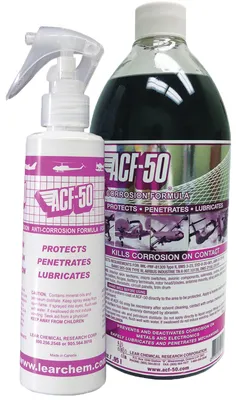
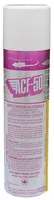
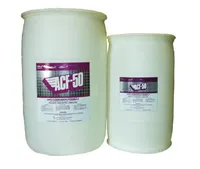
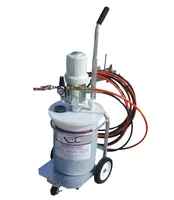
Does ACF-50 dry or does it remain moist?
ACF-50 is active, so there will always be a bit of film.
Can ACF-50 be used inside light aircraft fuel tanks to provide a corrosion inhibiting coat?
This is not recommended to be used inside light aircraft fuel tanks. This is not an area wehre ACF-50 was designed. It would mix with the fuel and can cause other issues.
Is ACF-50 safe to use on a bonded aircraft structure? Will it attack or penetrate the bond material?
ACF-50 will not negatively effect bonded structures in any way. It is perfectly safe for "all" composite aircraft structures.
How does ACF-50 do on chrome? Is there any discoloration?
This product works well on chrome and should not cause discoloration. ACF recommends using with a micro-fiber cloth.
Can ACF-50 be shipped by air?
Only the aerosol is considered HazMat for shipping and is unable to ship by air.
What is the shelf life on ACF-50?
According to manufacturing certs, this product is best used within two years of the date of manufacture.
Can I paint over an application of ACF-50?
Per the manufacturer, no you cannot paint over it.
Can the ACF-50 corrosion block be used on the interior of an aircraft?
Yes, it can be used inside the aircraft.
What is the brush part number for the AL12-EI60 (99-1012), C14-50, and EX14-50?
The brush block/regulator assembly used in the Plane Power C14-50, EX14-50 and AL12-EI60 alternator is part number 11-1043.
If the surface already has corrosion, will the application of this material visibly remove the corrosion?
According to the manufacturer, if the surface has corrosion then yes, it will visibly remove it. However, if the surface has rust, then no, it will not remove the rust. The customer would have to clean the areas that have rust and then apply ACF-50 to prevent any more rust from appearing.
What is the brush part number used in the Plane Power ER14-50 (15-1014)?
The brush block assembly used in the Plane Power ER14-50 alternator is part number 11-1013.
Do AeroShell Oil W 15W-50 and AeroShell Oil W 100 perform the same in an engine?
The oils are similar, but there are some differences. The biggest difference is in cold flow characteristics. AeroShell Oil W 100 is up to 10 times thicker at cold temperatures than AeroShell Oil W 15W-50. However, at normal operating temperatures (around 200°F), both oils will have the same thickness or viscosity. Another major difference is that AeroShell Oil W 15W-50 and AeroShell Oil W 100 Plus have an antiwear additive which is not in AeroShell Oil W 100. This additive, along with the semisynthetic base oils, helps reduce friction and improve flow in AeroShell Oil W 15W-50.
These additives improve lubrication and reduce oil consumption past the oil rings. Conversely, the improved flow can increase oil loss through leaks or loose intake valve guides. So your oil consumption may go up or down if you switch from AeroShell Oil W 100 to AeroShell Oil W 15W-50. The improved flow and reduced friction characteristics of AeroShell® Oil W 15W-50 will also help reduce oil temperatures as opposed to using AeroShell Oil W 100.
This is particularly important in engines that run hot, like turbocharged, high performance or aerobatic aircraft engines. Pilots should always remember to monitor oil temps to ensure that they’re not too hot.
In cold weather, you should also make sure that the engine temperature is high enough to boil off the water that naturally accumulates in the crankcase. Temperatures in the 180° to 200°F range are recommended for most applications. Finally, if you have a marginal or slipping starter clutch, the antiwear additive in AeroShell Oil W 15W-50 may cause it to slip more than AeroShell Oil W 100. Understanding these differences can help you select the grade of AeroShell that's right for your plane.
I need a new enable harness for my AL12-EI60 or ER14-50 Plane Power alternator. What is the part number?
The enable harness for the AL12-EI60 and ER14-50 Plane Power alternators is part number 11-1010.
Will the synthetic portion of semi-synthetic AeroShell Oil W 15W-50 harm an aircraft engine?
A number of pilots have asked this question. The answer is a definite no. When Shell first started evaluating multigrade aviation piston-engine oils over 25 years ago, testing proved that multigrades formulated only with mineral base oils did not have adequate base oil viscosity (thickness) to properly lubricate all high load points in the engine. Then we tested and flight evaluated a formulation made with all-synthetic base oils.
This formulation had excellent antiwear characteristics in all tests run. However, in the flight evaluations, some engines would reach 600 to 900 hours, then lose oil consumption control and/or compression. When the engines were disassembled, we found that the piston rings were covered with a gray tacky substance that was primarily made up of the lead by-products of combustion (from the use of leaded aviation gasoline).
Although synthetics are excellent lubricants with good high temperature stability and very good low temperature flow characteristics, they are relatively poor solvents.
In an aircraft engine, the lead by-products of combustion must be dissolved by the base oil so they can be carried away from the ring belt area and removed from the engine when the oil is changed. Anticorrosion, antiwear AeroShell Oil W 15W-50 is formulated with 50% synthetic base oils to give it the excellent low temperature flow needed for quick lubrication during cold starting.
The synthetic base oils, along with the unique antiwear additive system, give it antiwear protection unequaled by any other product on the market. In addition, its mineral base oils provide lead absorbency to guard against ring sticking and excessive sludge. The bottom line: The synthetic component of AeroShell Oil W 15W-50 will not harm your engine. Instead, it gives you the best of both oils.
How long has MT been making propellers?
MT-Propeller began making natural composite propellers in 1980. Over 50,000 blades are in action with no in flight failures.
I like to use multigrade oil for better cold stars, but like protection of single grade oil. How can I get the best of both?
The old adage that one should never change oil types was based on problems with some oils with very “unusual” technology that were in the marketplace over 50 years ago. Present oils are compatible. So many pilots use AeroShell Oil W 15W-50 multigrade in the winter months and then switch to AeroShell Oil W 100 or AeroShell Oil W 100 PLUS single grade in the summer months. You may see small changes in oil temperature or oil consumption with this change, but it will not hurt your engine.
Can I replace rivets with screws when replacing my seat rails?
Yes, but there are some restrictions. The screws must be structural screw with a minimum tensile strength of 50ksi. See SAIB CE-90-03R2 for more details.
How often should I replace my Tempest oil filter?
Always refer to the engine manufacturer’s recommendation. If no recommendation is made then we suggest you replace Tempest oil filters every 25 to 50 hours.
Do all AeroShell oils meet SAE specifications?
Yes. AeroShell straight mineral oils meet the SAE J-1966 former MIL-L-6082 specification. AeroShell Oil W single grade and antiwear, anticorrosion AeroShell Oil W 15W-50 meet the SAE J-1899 former MIL-L-22851 specification. The AeroShell containers are labelled with both the new SAE specifications and the “former” military specifications.
What does it weigh?
SIM4P - 4.4 lbs.
SIM4N - 4.0 lbs.
SIM6C - 5.0 lbs.
SIM6L - 5.2 lbs.
Does using your shorter oil filter design have a negative effect on filtering my engine’s oil?
The short answer is no. While we recommend using our taller oil filters when you have the space inside your cowling, using our shorter filters will still provide more than enough filtration coverage when replacing them at the recommended intervals of 25 to 50 hours.
What cockpit interfaces do the CiES digital fuel sender interface to?
We can output a DIGITAL SIGNAL to:
- Garmin G950, G1000,
- G500/G600 TXi, G3X, GI275
- Aerospace Logic FL20XD Series
- JPI 900, 930, 960
- EI CGR-30 & MVP-50
Can I switch from a straight AeroShell mineral oil to a single grade ashless dispersant oil?
All AeroShell oils are compatible and can be mixed with each other. Many single grade customers try AeroShell Oil W 15W-50 during the colder part of the year, then convert to using it year round. Others, however, choose to alternate between single grade and multigrade depending on the time of year. Either system works well because AeroShell oils are entirely compatible and can be interchanged as desired.
In addition, if you need to replace a cylinder on a mid-time engine, you can switch from AeroShell Oil W single grade or AeroShell Oil W 15W-50 to a straight AeroShell mineral oil for one or two changes to break in the new cylinder. Then you can switch back to the ashless dispersant oil after the rings are properly seated.
If you have a mid-time engine that has been run exclusively on a straight mineral oil and wish to try an ashless dispersant oil, use caution. The introduction of an ashless dispersant oil into your engine could loosen up some of the carbon deposits. So check your oil screens and filters often to ensure against oil starvation and/or oil screen collapse.
I just installed my EarthX battery in my aircraft and started the engine and my charging amps was really high, is this normal?
Yes, this is normal. A lithium battery can and will accept a much higher charging current than an equal size lead acid battery. If your battery is not fully charged, your alternator can potentially output a current equal to or slightly above the alternator’s rating for a few minutes to top the battery off. Your fuse, breaker, or current limiting device should be sized approximately 20% above the alternator rating. Example, if you have a 40 amp alternator, use a fuse, breaker, current limiter set to 48 amps (or 50 amps).
Are AeroShell multigrade and AeroShell single grade oils compatible?
The compatibility question covers two issues: mixing one grade of AeroShell oil with another; and the effects on the engine of changing from one AeroShell grade to the other. If you typically run on AeroShell multigrade, and you find yourself in a place where only AeroShell single grades are available, you can safely add the AeroShell single grade to your engine. They are completely compatible.
If you run on an AeroShell single grade during the summer, but want to switch over to AeroShell Oil W 15W-50 Multigrade for the winter, you can safely replace the straight weight with the multigrade at your regular drain interval. The idea that you have to stick with the type of oil you started with comes from the days of unusual chemistry when the resulting oils were incompatible.
All approved SAE J-1899 (former MIL-L-22851) and SAE J-1966 (former MIL-L-6082) AeroShell oils are compatible. For example, if you have a high-time engine run on ashless dispersant oils and need to replace a cylinder, you can switch to a mineral oil for 50 hours or so to break in the new cylinder. The only time Shell recommends against switching is in a high-time engine run exclusively on straight mineral oil. Here, a switch to ashless dispersant oil can loosen deposits left behind by the mineral oil.
If my aircraft engine has a Supplemental Type Certificate for automotive gasoline, can I break in?
No. Most of the metallurgy in the valve train of aircraft engines was designed to be operated on leaded fuels. Even 80/87 engines were designed for fuels with 0.5 gram per gallon lead. Experience has shown that the lead level in aviation gasoline is especially critical during break-in. So, if you’re breaking in a new or an overhauled engine, make sure you use a leaded 80/87 or 100/130 low lead aviation gasoline for at least the first 50 hours of operation. Some fuel suppliers sell an unleaded 80/87, so make sure you're getting leaded gasoline for breaking in your engine.
My oil temperature seems to be running low. Is this a problem?
Yes, low oil temperature can lead to excessive rusting and corrosion of critical engine parts. When an aircraft sits on the ramp or in a hangar, the engine heats up during the day and cools again at night. While the engine is cooling, some of the moisture in the air condenses on the engine walls and drops into the oil.
This can form rust on internal engine components. The moisture can also react with by-products of combustion in the oil,forming acids which can lead to corrosion. The best way to remove this water is for the engine to boil it off during flight. Studies have shown that the temperature of your engine oil increases about 50°F as it circulates through the engine.
Therefore, unless the oil temperature reaches 170°F to 180°F during flight, the engine will not boil off the water that has accumulated in the crankcase. The result: rust and corrosion.
Note that an excessively high oil temperature will also cause problems. Here are some tips to help avoid oil temperature problems:
Check your oil temperature gauge for accuracy. It should read about 212°F when the sensor is placed in boiling water.
Monitor the oil temperature during flight. It should be about 180°F even in winter. If it is lower, you may need a winterization kit. Otherwise, check with your mechanic to see what is causing the excessively low oil temperature.
The unique additive feature in anticorrosion/antiwear AeroShell® Oil W 15W-50 can also help control problems caused by rust and corrosion.
How often should I charge the battery?
Only when needed which is when the voltage reads below 13.28V. It depends on the battery model (the larger amp hour batteries will need less topping off than say the scooter battery) but if not in use or left in a vehicle, make sure you check the voltage and charge at least once a year. Due to lithium batteries extremely low self-discharge rate, less than 50% of its charge is lost over a 6 month period, so you may not have to charge your battery before the season starts! If the battery is 13.28V or higher, then all is good. If it is less than this, you need to charge it before engine start to ensure a long battery life.
What is Bi-Flex and will it cost more than standard baffle seal material?
McFarlane manufactures a patented, Teflon-bonded, reinforced silicone rubber baffle seal material that gives you 30 times less friction on one side. Bi-Flex is our trade name for the laser scoring of this material to give maximum flexibility only where it is needed. For more information, please read Customized Flexibility for Optimal Cooling.
Yes, Bi-Flex costs 25% to 50% more for the extra processing and it will take a little longer to install, but this cost is small compared to the cost of cowling repairs and other damage from the engine movement that is transferred into the cowling and airframe. You will see a drastic reduction in cowling wear, cracks, and fastener fretting. You will also see a lot less cracking and damage to the metal engine baffles.
How often should I change my oil?
A good rule of thumb for changing piston engine oil is to change it every four months. Of course for every rule, there are at least two exceptions.
Exception #1: If you're able to fly frequently with proper oil temperature, you should adjust the four-month rule accordingly. Change out your oil after 50 hours if you've flown the hours in less than four months. If your engine doesn’t have an oil filter, change it after 25 hours. Always remember: the four-month rule is the most critical.
Exception #2: In recent years, the annual flight hours of many private planes have decreased.
And where there’s an idle plane, there’s rust. When an airplane engine sits too long (especially in humid climates or if there is excess moisture in the oil because the oil temperature is too low), rust will form on many of the parts such as cams, lifters and cylinders. Then, once the plane has been started, the iron oxide will run through the entire engine oil system.
While some of the larger pieces will filter out, many of the smaller pieces will remain in the oil and can act as grit on critical wear surfaces. If you don't plan on flying your aircraft for four months or more, be sure to use a storage or preservative oil to protect your engine.
Why does my starter engage intermittently?
There are two potential causes of this condition. If it is a mechanical starter drive (Bendix) and sticks intermittently, it most likely needs to be lubricated. This type of starter drive is initially lubricated to allow smooth operation. The drive gear must move in and out and also rotate. In use it can become dry and may begin to stick and fail to engage or disengage. We recommend lubricating this type of starter drive every fifty (50) hours of operation.
The other likely factor for intermittent engagement would be a faulty starter contactor. If you want to check a contactor, it is best to do so with a load applied. Resistance in the contactor, even a fraction of an ohm, is enough to produce poor or no operation due to the high current field. In a 12-volt starting circuit drawing 60 amps, for example, the addition of 0.2 ohms of resistance due to an oxidized connector or carbonized contact may drop the current to the load to 36 amps. This is a 40-percent loss in starter operating power caused only by a 0.2-ohm resistance.
Checking the circuit without a load would require that a lot of resistance be placed in line. The best method of checking the contactor is to disconnect the lead from the starter and connect it to a battery load-meter tester. Activate the contactor and check the voltage on each side of the contactor. A 0.1-volt drop is normal for a new or nearly new contactor. If you find any more than 0.3-volt drop, replace it.
What can I do to ensure the accuracy and value of an oil analysis?
Oil analyses can help you discover engine problems before they turn into major failures. But the analysis information gained is only as good as the sampling procedure. Also, a single test is not enough to reveal trends and significant changes and can only tell you if there is already a serious problem like a scuffed piston. Take oil samples properly. For best results, take the sample about midway through the draining of hot oil from your sump.
A sample pulled off at the beginning or end of the oil change may appear dirtier than it really is. Sample the oil the same way every time. An improperly taken sample can lead to some seriously inaccurate conclusions about engine malfunctions. Rely on a series of consistent tests over time. You’re looking for significant changes or trends over time, not absolute values.
People want to label the results of a single test as good or bad, but the system doesn’t usually work that way. Say you’re buying a used aircraft. Don’t rely on just one very good result of just one report – it could have come from a 5- or 10-hour sample. Relatively constant numbers from the last six oil changes are a far better indicator that the engine is in good condition. Your record of regular oil changes and analyses is also helpful when selling an aircraft.
Be consistent. If you change your oil at 50 hours, and then at 25 hours the next time, the first sample may show twice the wear metals. (Expect higher wear metals during break-in or following some maintenance procedures such as a cylinder replacement.) Finally, always remember that oil analysis should be part of a good maintenance programme, not a replacement for one.
How important is preheating my engine?
Preheating your engine makes a world of difference. This procedure heats the oil so it’s thin enough to flow through the engine and properly lubricate all critical wear surfaces. Preheating also heats the metal parts in the engine. That’s important because aluminum crankcases have a higher coefficient of thermal expansion than iron crankshafts.
This means as your engine cools down, the clearance is reduced. And as a result, you may not have sufficient oil film thickness for proper hydrodynamic lubrication at very cold temperatures. In other words, the wear rate is going up.
One final note of caution on heaters: Do not plug in a heater and leave it on for extended periods of time. If you have moisture in your oil, the heater will increase vaporization, which will condense on the cool, nonheated engine parts and increase rusting.
Airplane air/oil separators are also worthy of discussion. Separators are designed to remove the oil from the blow-by gas and return it to the crankcase. This reduces oil consumption and keeps the belly of the airplane clean. Properly installed, separators work well.
However, if the system is installed with parts in a cool area under the engine cowling, it can condense all of the water evaporated from the oil and return it to the crankcase.
If you have a separator, make sure it’s properly installed with the exit tube in a low pressure area which will evacuate the water vapor and not force it back into the crankcase. While preheating and the proper air/oil separator are essential to long engine life, they are no more essential than the oil you use. AeroShell® Oil W 15W-50 offers unsurpassed anticorrosion and antiwear protection for all kinds.
How can I make sure my oil temperature is accurate and identify the correct oil temperature range?
Placing a permanent reference mark at 180°F on the green band of your oil gauge is a good way to get accurate readings. To do this, simply place your sending unit and an accurate, referenced thermometer in a steel container filled with oil, and slowly heat it to 180°F with a hot plate. You may not be able to hold 180°F constant, so first mark your gauge with a pencil as the oil temperature passes 180°F. Then let the oil cool back to 180°F. Repeat the process to ensure accuracy.
And be extra careful with the hot oil. In a naturally aspirated aircraft engine, a cruise oil temperature significantly below 170°-180°F will not ensure that the moisture in the oil is boiled off, especially during short flights. As oil goes through the engine, the highest instantaneous temperature will be about 50°F higher than the oil sump temperature.
So, if you have an oil temperature of only 150°-160°F, the oil will not get above the 212°F necessary to boil off the water that can accumulate from condensation. The result is increased moisture and acid buildup in the crankcase, which will probably lead to rust and corrosion.
Knowing this is especially critical if your aircraft is not flown regularly and sits in a humid climate for weeks at a time. If your oil runs well below the 180°F mark, have your mechanic check your oil cooler system and vernatherm. Also, ask about a winterization kit.
Conversely, the concern with the typical turbocharged piston engine is excessive heat. In many of these engines, instantaneous oil temperature can increase 70°F or more at its hottest point versus sump temperature. These high temperatures can cause deposit buildup and increased wear due to improperly cooled components or low oil viscosity. (All oils, especially single grade oils, thin out as the temperature