Your Cart
Items
Seat Rails for Cessna and Piper Aircraft
Cessna Seat Rails
- Carefully engineered with many improvements
- Added strength and longer life
- Anodized for corrosion and wear resistance
- Easier installation
- Full interchangeability with the original Cessna parts
For guidance on the replacement of fasteners, see FAA Special Airworthiness Information Bulletin CE-90-03R2.
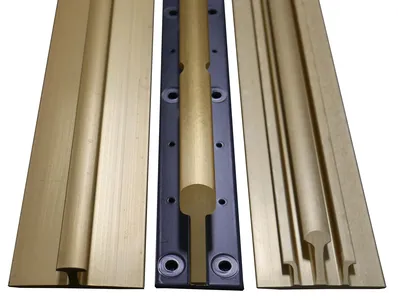
No Pre-Drilled Rivet Holes for Precise Installation
McFarlane seat rails do not have pre-drilled rivet holes in the rail base allowing the installer to exactly match the aircraft floor rivet pattern. McFarlane discovered while installing and developing our replacement seat rails that the seat rail attachment hole pattern was not consistent from aircraft to aircraft. Even small inconsistencies in the hole locations in the aircraft floor make installation of new seat rails very difficult. For this reason, McFarlane does not pre-drill rivet holes at the factory. (Existing stock may have a few pilot attachment holes drilled at the factory.) This allows the installer to precisely locate the attachment holes to match the holes in the aircraft floor. All special sized or machined attachment holes are machined to finish dimensions. It is necessary to replace all fasteners when the seat rails are installed.

More Material in the Right Places
After studying countless worn and failed seat rails McFarlane's rails were designed with 15% more metal in critical areas. The result is more crack resistance, durability, strength and longer life.
Piper Seat Rail
- Direct replacement
- Precision machined
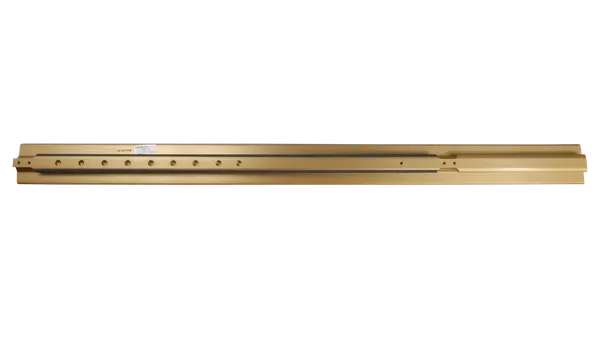
- Gold anodized for corrosion resistance
- Dry lubricant applied for long service life

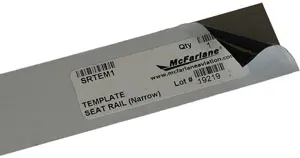
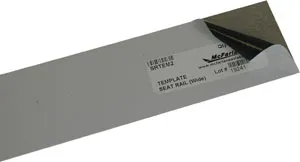
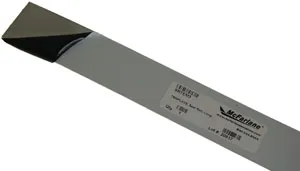
Templates make the job of transferring the original Cessna rivet hole pattern from the old seat rail to the new seat rail easy!
- Inexpensive
- Achieve a precise fit every time
Models 150-152 do not require templates as the screw holes are predrilled. Model 177 Cardinal seat rails require one (1) SRTEM3 templates per rail. Seat rail series MC0511240, MC0511243, MC0514209 and MC2414002 use SRTEM2. All other rail series use SRTEM1.

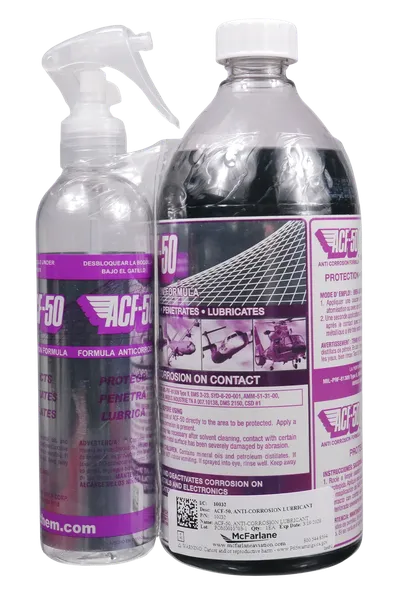
Lear Chemicals Corrosion Preventer
ACF-50 Anti-Corrosion Formula is a state-of-the-art anti-corrosion lubricant compound, specifically designed for the Aerospace industry. ACF-50’s unique chemistry offers excellent penetration, coupled with an unmatched 24 months of “active” corrosion protection. Designed specifically to perform as both a Corrosion Inhibiting Compound (CIC) and a Corrosion Prevention Compound (CPC). ACF-50’s blend of non-flammable, non-toxic, polar bonding inhibitors and moisture-displacing additives penetrate deep into corrosion cells to actively remove electrolytes. No longer in contact with the metal surface, these electrolytes evaporate. ACF-50’s resulting dielectric fluid film acts as an “off-switch” for the corrosion process.